Gorilla Trekking in Rwanda
Cost, What to Wear, and How to Prepare
When my husband asked what I wanted for my birthday, I said: gorilla trekking in Rwanda.

Then I saw the permit price — $1,500 per person.
Gorilla trekking in Volcanoes National Park is not standard tourism. It is a tightly regulated conservation experience designed to protect endangered mountain gorillas while funding rangers, trackers, veterinary teams, and surrounding communities.
You don’t choose the gorilla family.
You don’t control the weather.
You don’t choreograph the moment.
You enter their environment under rules built to protect them.
Standing there — seven meters away — I finally understood why the permit costs what it does.
For me, it was worth it.
If you’re considering gorilla trekking in Rwanda, here’s what to know before you book.
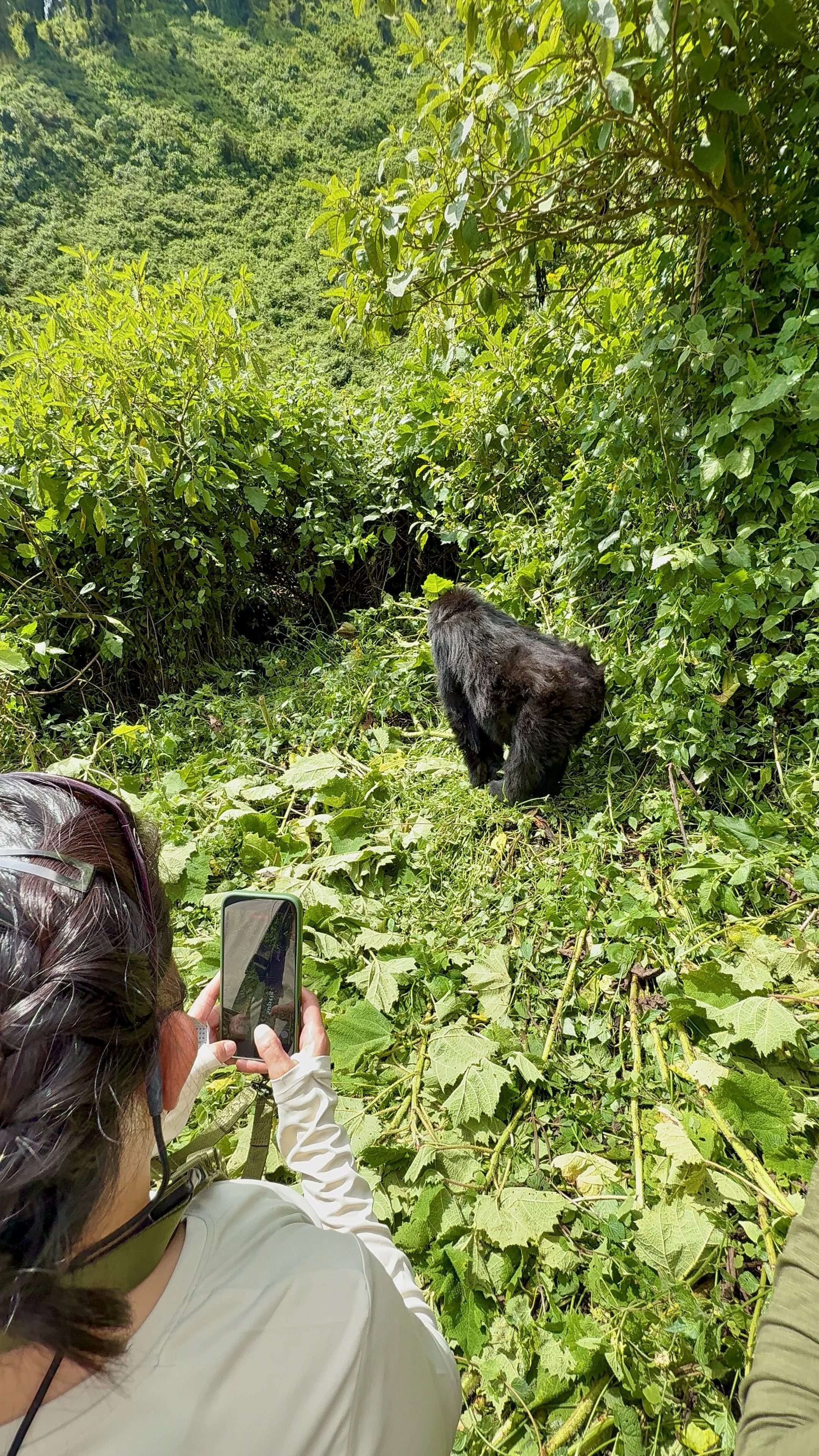
What Are Mountain Gorillas?
Mountain gorillas live in the Virunga mountain range, a chain of volcanic highlands that spans three countries: Rwanda, Uganda, and the Democratic Republic of the Congo.
Gorilla families move naturally across these forests depending on food availability and group dynamics. The ecosystem is shared — even if political boundaries are not.
Gorilla trekking in Rwanda focuses on the endangered mountain gorilla (Gorilla beringei beringei), one of the rarest great apes in the world.
They live only in the high-altitude forests of the Virunga Mountains, protected in Rwanda within Volcanoes National Park and the Bwindi Impenetrable Forest region in Uganda. They are not found in zoos. Visiting the gorillas in their natural habitat is the only way to see this species - under strict conservation rules.
Mountain gorillas live in family groups led by a dominant male known as a silverback.
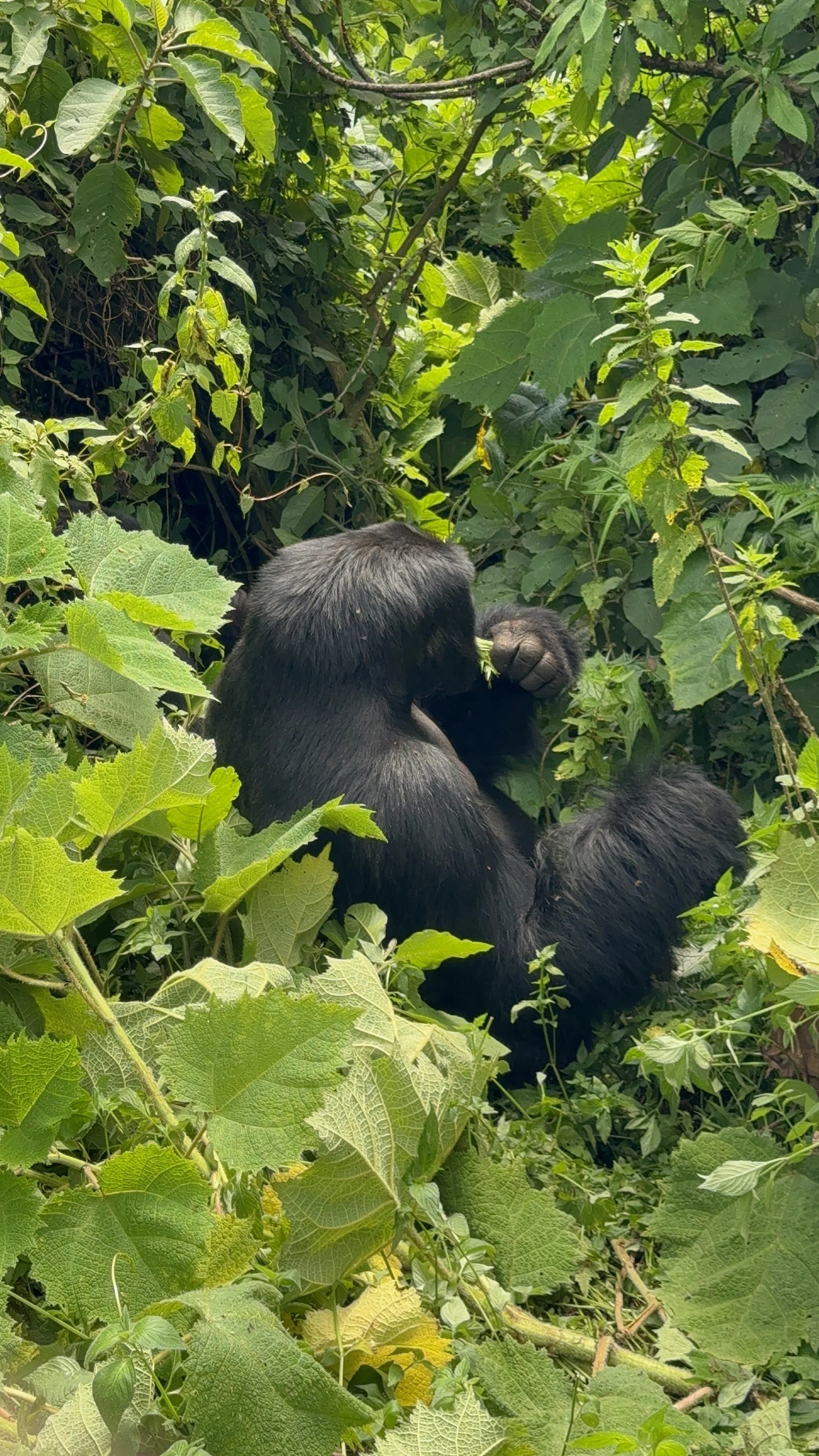
A silverback is an adult male, typically over 12 years old, whose back hair turns silver as he matures. He is responsible for protecting the group, mediating conflict, and determining movement. His presence maintains cohesion.
A gorilla family may include: One dominant silverback, one or more subordinate silverbacks, adult females, juveniles, and Infants. Family structures are dynamic. Younger males may eventually leave to form new groups. Leadership is visible, but not loud.
The family we visited was a relatively new group of 12 members led by the silverback Izuwa.
Watching Izuwa move through the forest — steady, deliberate, aware — made the social hierarchy tangible. The group responded to him without hesitation. Authority did not require aggression.
It was calm. Controlled. Quiet.
The family had been “habituated,” meaning they had gradually become accustomed to limited human presence under careful supervision. Habituation takes years.
We entered the space of a wild, social, intelligent species — under strict rules designed to protect them.
Is Gorilla Trekking in Rwanda Worth the Cost?
Rwanda is a country that has rebuilt itself deliberately.
Clean roads.
Strict enforcement.
Visible structure.
That same intentionality shows up in gorilla trekking.
Every movement feels coordinated — from the morning ranger briefing to the trackers who leave before sunrise to locate the gorilla family.
This is not chaotic tourism.
It is organized conservation.
And that difference matters.
Each permit allows one regulated hour with a habituated mountain gorilla family. Groups are limited to eight visitors. Rangers guide the trek. Trackers meet you at the site. Distance rules are strictly enforced for the human visitors. For the mountain gorillas, well…., one came close to brushing my shoulder as it walked behind me.
What you are not paying for:
Easy trails.
Dry conditions.
Perfect photographs.
Control over how long the gorillas remain visible.
You might hike 30 minutes.
You might hike four hours. Or six.
That unpredictability is part of the experience.
For me, the cost made sense once I understood the system behind it.
Where Does the Permit Fee Go?
Before we booked, I wanted clarity.
The $1,500 permit supports:
• Park rangers
• Trackers who leave before sunrise
• Anti-poaching patrols
• Veterinary teams
• Revenue shared with surrounding communities
Only 96 permits are issued per day in Rwanda. Spread out to 12 habituated gorilla families.
Standing seven meters away from one of the gorilla families, it felt like I stepped into a conservation system built deliberately with safety and conservation combined.
What to Wear
I regret not wearing gloves.
The rangers said we didn’t need them. I listened.
I shouldn’t have.
You will move through mud, dense vegetation, and stinging nettles. I came home with rashes on my hands and even legs.
Bring:
•Thorn proof garden gloves with touchscreen fingers
• Long sleeves
• Waterproof hiking boots
• Waterproof pants and gaiters
• A hat and sunglasses
• A lightweight hiking daypack that you can wash after.
You will step in mud (and gorilla/elephant/buffalo poop).
You’re not hiking for aesthetics.
You’re hiking for access.
Physical Preparation
Gorilla trekking isn’t technical — but it is physical.
As soon as our permit was confirmed, I began training. Not because I’m athletic — because I didn’t want to slow anyone down.
Incline treadmill walks.
30–40 minutes per session. I aimed for 4x a week.
Gradually increasing from 5–6% to 8–10%.
It worked. I wasn’t out of breath. I felt steady on the climb.
What I didn’t anticipate was standing in full sun for most of our hour. I returned home with a sunburned scalp.
Preparation helps.
Best Time to Go
Gorilla trekking operates year-round.
Dry seasons (June–September, December–February) usually mean firmer trails.
Rainy seasons (March–May, October–November) bring heavier mud and denser vegetation.
When we went, it wasn’t the ideal travel window for me. But permits were available, the forest was green, and the experience felt uncrowded.
Weather matters.
Availability matters more.